
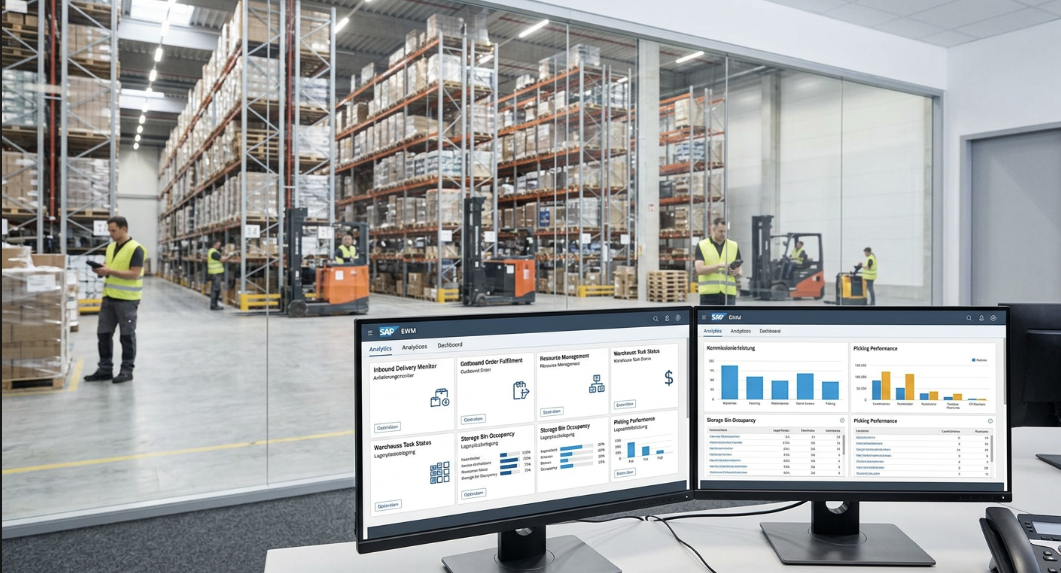
Introduction to Warehouse Digital Transformation
The modern supply chain industry is undergoing rapid digital transformation. Businesses today are expected to deliver products faster, maintain accurate inventory, reduce operational costs, and provide real-time visibility across warehouse and logistics operations.
Traditional warehouse management methods are no longer sufficient for handling the complexity of modern supply chains. To stay competitive, organizations are adopting technologies such as automation, AI-driven analytics, IoT tracking, robotics, and intelligent warehouse management systems.
Among these technologies, SAP Extended Warehouse Management (SAP EWM) has emerged as one of the most powerful solutions for managing advanced warehouse and supply chain operations.
What is SAP EWM?
SAP Extended Warehouse Management is an advanced warehouse management solution developed by SAP that helps businesses efficiently manage warehouse operations, inventory movement, and supply chain logistics.
SAP EWM supports:
- Goods receipt and goods issue
- Inventory and stock management
- RF (Radio Frequency) operations
- Warehouse automation
- Labor management
- Wave management
- Real-time warehouse monitoring
- Integration with SAP S/4HANA
It is designed for businesses that require high warehouse efficiency, automation, and real-time operational visibility.
Growing Need for Smart Warehouse Operations
Modern warehouses face several operational challenges:
- Faster customer delivery expectations
- Increasing e-commerce demand
- Complex inventory movement
- Multi-location warehouse operations
- Rising operational costs
- Need for real-time inventory tracking
- Pressure for higher accuracy and efficiency
Traditional warehouse systems struggle to manage these complexities effectively.
SAP EWM helps businesses address these challenges through:
- Intelligent automation
- Real-time stock visibility
- Optimized warehouse processes
- Faster order fulfillment
- Better operational control
Key Features of SAP EWM
1. Inbound & Outbound Processes
SAP EWM streamlines both inbound and outbound warehouse operations.
Inbound Processes:
- Goods receipt
- Putaway management
- Quality inspection
- Cross-docking
- ASN processing
Outbound Processes:
- Picking
- Packing
- Shipping
- Delivery processing
- Route planning
This improves warehouse speed, efficiency, and accuracy.
2. RF Operations
SAP EWM supports RF (Radio Frequency) devices that allow warehouse workers to:
- Scan barcodes
- Confirm inventory movement
- Perform picking activities
- Update stock in real time
This reduces manual errors and increases operational productivity.
3. Wave Management
Wave management groups warehouse tasks for optimized execution.
Benefits include:
- Faster order processing
- Better labor utilization
- Reduced picking time
- Improved warehouse productivity
This is especially important for high-volume warehouses and e-commerce businesses.
4. Inventory Management
SAP EWM provides advanced inventory management features such as:
- Batch management
- Serial number tracking
- Cycle counting
- Real-time stock monitoring
- Inventory reconciliation
This improves inventory accuracy and minimizes stock discrepancies.
5. Warehouse Automation
Modern warehouses increasingly rely on:
- Conveyor systems
- Automated Storage & Retrieval Systems (AS/RS)
- Robotics
- AGVs (Automated Guided Vehicles)
- IoT-enabled devices
SAP EWM integrates effectively with these automation technologies to create smart warehouse ecosystems.
6. Real-Time Stock Visibility
Real-time inventory visibility is one of the biggest advantages of SAP EWM.
Businesses can:
- Monitor stock instantly
- Track warehouse activities
- Improve replenishment planning
- Reduce stock-outs
- Make faster business decisions
This enables more agile and responsive supply chain operations.
7. Integration with SAP S/4HANA
SAP S/4HANA integration enables seamless connectivity between warehouse operations and other business functions such as:
- Procurement
- Manufacturing
- Sales
- Transportation
- Finance
- Supply chain planning
This creates a fully integrated digital enterprise environment.
Real-Time Industry Use Cases
Retail & E-Commerce
SAP EWM helps retailers manage:
- High-volume inventory
- Fast order fulfillment
- Same-day delivery operations
Manufacturing
Manufacturers use SAP EWM for:
- Production supply management
- Raw material tracking
- Finished goods inventory
Pharmaceuticals
Pharmaceutical companies use SAP EWM for:
- Batch tracking
- Regulatory compliance
- Sensitive inventory management
Automotive
Automotive companies use SAP EWM for:
- Spare parts management
- Just-in-time inventory
- Automated warehouse operations
Why Companies Prefer SAP EWM Over Traditional Warehouse Systems
Organizations increasingly choose SAP EWM because it offers:
- Higher warehouse efficiency
- Real-time analytics
- Better inventory accuracy
- Faster order fulfillment
- Advanced automation support
- Scalability for global operations
- Improved customer satisfaction
- Better operational visibility
These capabilities are essential for modern supply chain competitiveness.
Career Opportunities in SAP EWM
As businesses worldwide adopt digital warehouse technologies, demand for SAP EWM professionals continues to grow.
Popular career roles include:
- SAP EWM Consultant
- SAP Functional Consultant
- Warehouse Solution Architect
- Supply Chain Analyst
- SAP Logistics Consultant
- Warehouse Automation Specialist
Industries actively hiring SAP EWM professionals include:
- Retail
- Manufacturing
- Pharmaceuticals
- Logistics
- Automotive
- E-commerce
Professionals with strong SAP EWM expertise are highly valued because intelligent warehouse management has become a strategic business requirement.
Will AI Replace SAP EWM Consultants?
One of the biggest questions in the industry today is whether Artificial Intelligence will replace SAP EWM consultants.
The answer is no — AI will transform the role, not eliminate it.
Warehouse operations are highly complex and require:
- Business understanding
- Process optimization
- Real-world problem solving
- System integration expertise
- Client communication
- Warehouse design knowledge
AI can automate repetitive tasks and provide intelligent recommendations, but businesses still need skilled professionals to:
- Configure SAP EWM systems
- Design warehouse processes
- Integrate automation technologies
- Solve operational challenges
- Optimize supply chain workflows
- Handle real-time business scenarios
In fact, as companies invest more in:
- Smart warehouses
- Real-time inventory systems
- Robotics integration
- Cloud ERP migration
- End-to-end supply chain visibility
the demand for skilled SAP EWM professionals is actually increasing.
The future belongs to consultants who combine:
- SAP EWM expertise
- Supply chain knowledge
- Business understanding
- Automation awareness
- AI familiarity
Consultants who adapt to new technologies and continuously upgrade their skills will remain highly valuable in the evolving supply chain industry.
Importance of Practical Hands-on Learning
Learning SAP EWM theoretically is not enough for real industry projects.
Practical hands-on experience is essential for understanding:
- Warehouse configuration
- RF framework setup
- Putaway & picking strategies
- Integration scenarios
- Testing & troubleshooting
- Real-time warehouse execution
Hands-on learning through live projects and scenario-based training helps professionals gain confidence and become industry-ready.
Students and working professionals should focus on:
- System practice
- End-to-end warehouse scenarios
- Real-time business processes
- Practical implementation exposure
This practical experience significantly improves career opportunities in SAP EWM.
Conclusion
Warehouse and supply chain operations are becoming increasingly digital, automated, and data-driven. Traditional warehouse systems are no longer sufficient to handle modern operational complexity.
SAP Extended Warehouse Management enables businesses to achieve:
- Intelligent warehouse management
- Real-time inventory visibility
- Advanced automation integration
- Faster order fulfillment
- Better operational efficiency
As industries continue moving toward smart warehouses and intelligent supply chains, SAP EWM is becoming a critical technology for modern enterprise operations.
For professionals looking to build a strong career in SAP and supply chain management, learning SAP EWM with practical hands-on experience can open significant career opportunities in the rapidly growing world of warehouse automation and digital logistics.
At HiTekMindz Consulting & Services, we focus on practical, industry-oriented SAP EWM training with real-time scenarios, implementation understanding, and hands-on learning approaches designed to align with current market expectations.
📧 info@hitekmindz.com
📞 +91 9167427159
🌐 www.hitekmindz.com
Building Skills. Delivering Technology.
Leave a Reply