
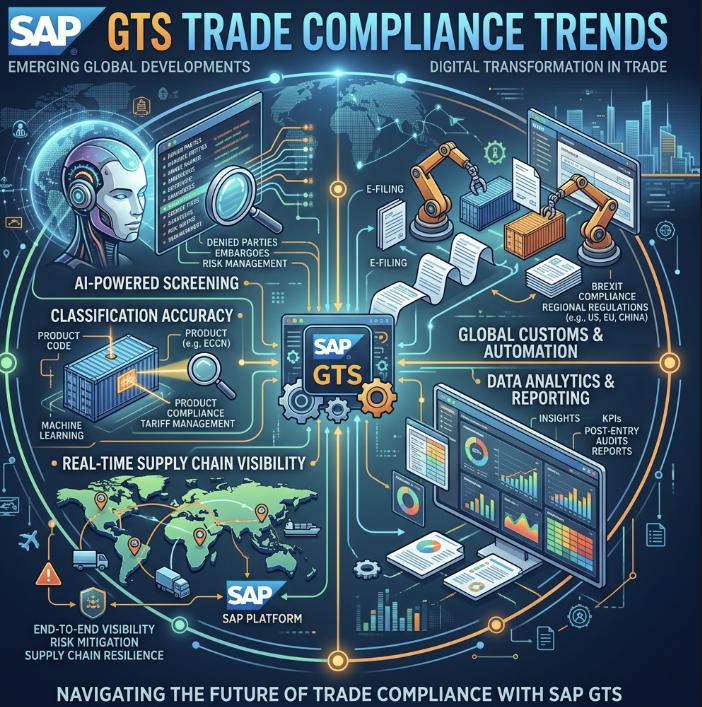
In today’s rapidly evolving global trade environment, organizations face increasing challenges related to regulatory compliance, customs management, trade agreements, and supply chain disruptions. As businesses expand internationally, effective trade compliance has become a strategic necessity rather than just a regulatory requirement.
SAP Global Trade Services (SAP GTS) continues to play a critical role in helping organizations manage global trade processes efficiently. Here are the top SAP GTS trends that trade compliance teams should watch in 2026.
1. Increased Focus on Trade Compliance and Regulatory Changes
Governments across the globe are continuously updating trade regulations, sanctions, export controls, and customs requirements. Organizations must ensure they remain compliant with these changing regulations to avoid penalties and operational disruptions.
SAP GTS enables businesses to automate:
- Sanctioned Party List Screening
- Export Control Checks
- Embargo Compliance
- Trade Documentation
As regulatory complexity increases, organizations are investing more in automated compliance solutions to minimize risk.
2. Growing Adoption of SAP GTS on SAP S/4HANA
Many organizations are accelerating their migration to SAP S/4HANA. As part of this transformation journey, SAP GTS integration with SAP S/4HANA has become a key focus area.
Benefits include:
- Improved data consistency
- Real-time trade compliance checks
- Enhanced reporting capabilities
- Streamlined business processes
Trade compliance teams should prepare for tighter integration between ERP and global trade functions.
3. Expansion of Trade Preference Management
With businesses looking to optimize costs and improve competitiveness, Trade Preference Management is becoming increasingly important.
Organizations are leveraging SAP GTS to:
- Manage Free Trade Agreements (FTAs)
- Determine product eligibility
- Automate origin calculations
- Reduce customs duties
As global trade agreements continue to evolve, companies that effectively utilize trade preferences can achieve significant cost savings.
4. Enhanced Customs Management and Automation
Customs processes are becoming increasingly digital across many countries.
SAP GTS Customs Management helps organizations:
- Automate customs declarations
- Manage import and export documentation
- Improve customs visibility
- Reduce processing delays
Automation not only improves compliance but also accelerates cross-border transactions.
5. Risk-Based Compliance Management
Modern compliance strategies are shifting from reactive approaches to proactive risk management.
Organizations are using SAP GTS to:
- Identify high-risk transactions
- Monitor compliance exceptions
- Improve audit readiness
- Strengthen governance controls
This trend enables compliance teams to focus resources on the most critical trade risks.
6. Greater Supply Chain Visibility
Global supply chains continue to face disruptions due to geopolitical events, regulatory changes, and economic uncertainty.
SAP GTS supports:
- Real-time trade monitoring
- Shipment visibility
- Regulatory compliance tracking
- Cross-border transaction transparency
Enhanced visibility helps organizations make faster and more informed decisions.
7. AI and Intelligent Automation in Trade Compliance
Artificial Intelligence is beginning to influence trade compliance processes through:
- Automated document classification
- Compliance risk detection
- Data validation
- Predictive analytics
Organizations that adopt intelligent automation can improve efficiency while reducing manual effort and compliance risks.
8. Increased Audit and Reporting Requirements
Regulatory authorities are demanding greater transparency and detailed audit trails.
SAP GTS provides:
- Comprehensive compliance reporting
- Audit-ready documentation
- Historical transaction tracking
- Centralized compliance records
This helps organizations respond quickly to audits and regulatory inquiries.
Conclusion
Trade compliance is becoming increasingly strategic for global organizations. Companies that leverage SAP GTS effectively can not only maintain compliance but also improve operational efficiency, reduce costs, and gain a competitive advantage.
As we move through 2026, Trade Compliance, Customs Management, Trade Preference Management, S/4HANA Integration, and Intelligent Automation will continue to shape the future of global trade operations.
Organizations that stay ahead of these trends will be better positioned to navigate an increasingly complex international trade landscape.
#SAP #SAPGTS #TradeCompliance #CustomsManagement #TradePreferenceManagement #GlobalTrade #SupplyChain #SAPS4HANA #DigitalTransformation #HiTekMindz
Leave a Reply