
Introduction
Enterprise Resource Planning (ERP) systems help organisations manage and integrate essential business processes, including finance, procurement, sales, manufacturing and supply chain operations.
SAP ERP Central Component (ECC) has been widely used by organisations to manage these processes. SAP S/4HANA is a modern ERP suite designed to support integrated business operations through an updated data model, modern user experiences and advanced reporting capabilities.
Understanding the differences between SAP ECC and SAP S/4HANA can help organisations evaluate their technology options and help SAP professionals identify relevant learning and career development opportunities.
In this guide, we explore the key differences, potential benefits, migration approaches and skills that professionals can consider when working with SAP technologies.
What Is SAP ECC?
SAP ECC stands for SAP ERP Central Component. It is an enterprise resource planning system that helps organisations manage their core business operations.
Common functional areas include:
- SAP FI/CO: Financial Accounting and Controlling
- SAP MM: Materials Management
- SAP SD: Sales and Distribution
- SAP PP: Production Planning
- SAP QM: Quality Management
- SAP PM: Plant Maintenance
- SAP HCM: Human Capital Management
These functional areas work together to support business processes and information flow across departments.
For example, a procurement transaction may affect inventory records and financial accounting, while a sales transaction can involve order management, delivery, inventory and billing.
Organisations often customise their SAP ECC systems to align with their business requirements, reporting needs and existing operational processes.
What Is SAP S/4HANA?
SAP S/4HANA is an enterprise resource planning suite built on the SAP HANA database.
It is designed to support integrated business processes, a simplified data model and modern user experiences.
Key characteristics include:
- SAP HANA database: Provides the underlying database platform.
- Simplified data model: Redesigns and simplifies data structures in many areas.
- Modern user experience: Supports SAP Fiori applications and role-based interfaces.
- Reporting and analytics: Provides capabilities for operational reporting and insights.
- Integrated business processes: Supports connected workflows across business functions.
- Updated business capabilities: Includes changes and enhancements across relevant functional areas.
The specific capabilities available depend on the product edition, deployment model and release.
Moving to SAP S/4HANA is not simply a database change. It may also involve reviewing business processes, custom developments, integrations, data structures, security roles and user experiences.
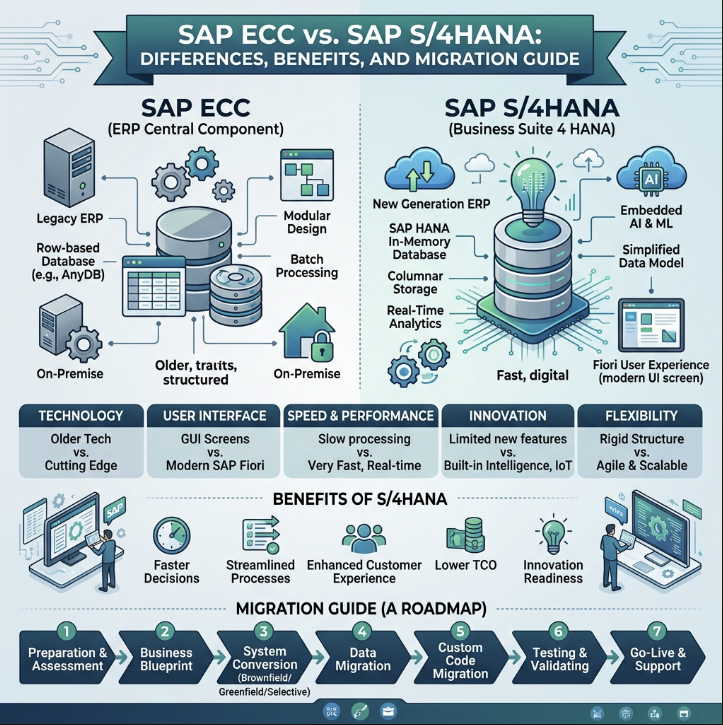
SAP ECC vs SAP S/4HANA: Key Differences
| Area | SAP ECC | SAP S/4HANA |
|---|---|---|
| ERP platform | Traditional SAP ERP suite | Modern SAP ERP suite |
| Database | Supports different databases, depending on the system configuration | Built to run on SAP HANA |
| Data model | Traditional ERP data structures | Simplified data model in many areas |
| User experience | Commonly uses SAP GUI | Supports SAP Fiori and applicable other interfaces |
| Reporting | Often uses traditional reporting tools and separate analytics components | Supports embedded analytics and operational reporting |
| Finance | Traditional financial accounting and controlling architecture | Includes the Universal Journal and updated finance capabilities |
| Materials management | Traditional procurement and inventory processes | Updated data structures and processes |
| Custom development | May contain existing custom programs and enhancements | Custom code may require assessment and adaptation |
| Integration | Depends on the existing system landscape | Supports integration with connected business applications and systems |
| Business processes | Based on the organisation’s existing configuration | Provides updated capabilities and opportunities to review processes |
The exact differences depend on the systems being compared, their configurations and the business processes in use.
Why Do Organisations Consider SAP S/4HANA?
Organisations may evaluate SAP S/4HANA for several business and technology reasons.
1. ERP Modernisation
Organisations can review their ERP landscape and evaluate opportunities to improve the way business processes are supported by technology.
2. Improved Access to Business Information
Reporting and analytics capabilities can help users access operational information and make more informed decisions.
The actual benefits depend on the system design, reporting requirements and implementation.
3. Business Process Improvement
A transition provides an opportunity to review existing workflows, identify unnecessary complexity and consider more standardised processes where appropriate.
4. Modern User Experience
SAP Fiori offers role-based interfaces for supported applications and can provide a more modern way for users to interact with business systems.
5. Review of Custom Developments
Organisations can assess existing custom programs and enhancements to determine which remain necessary and which could be simplified or redesigned.
6. Integration Across Business Functions
ERP modernisation can provide an opportunity to review how finance, procurement, sales, manufacturing and supply chain processes exchange information.
These are potential benefits rather than guaranteed outcomes. Successful implementation depends on business objectives, technical planning, process design and user adoption.
SAP S/4HANA Migration Approaches
Organisations can evaluate different approaches when transitioning from an existing SAP ERP environment to SAP S/4HANA.
The most appropriate approach depends on the current system, business requirements, data, customisations and desired level of process change.
1. System Conversion — Brownfield
A system conversion transforms an existing SAP ECC system into SAP S/4HANA.
This approach may be suitable when an organisation wants to retain much of its existing system configuration and business-process design, subject to compatibility and conversion requirements.
Key considerations include:
- Existing system configuration
- Custom-code compatibility
- Add-ons and integrations
- Data consistency
- Required process changes
- Testing and cutover planning
A system conversion does not necessarily mean every existing customisation or process can be carried forward unchanged.
2. New Implementation — Greenfield
A new implementation establishes a new SAP S/4HANA environment, with business processes and configuration designed around the organisation’s requirements.
This approach may be suitable when an organisation wants to redesign its processes, review existing customisations or substantially restructure its ERP landscape.
Key considerations include:
- Business process design
- Data migration and cleansing
- Integration requirements
- User training and adoption
- Organisational change management
- Testing and validation
A new implementation can provide opportunities for process improvement, but it also requires careful planning and coordination.
3. Selective Data Transition
A selective data transition moves selected data, organisational structures or processes into a target SAP S/4HANA environment using an appropriate transition approach.
It may be considered when an organisation requires a more tailored transition than a conventional system conversion or a complete new implementation.
Key considerations include:
- Selection of historical and transactional data
- Organisational changes
- Data transformation and reconciliation
- Source and target system compatibility
- Business-process requirements
- Transition tooling and planning
The feasibility of this approach depends on the existing landscape, target environment and business requirements.
How Should an Organisation Choose a Migration Approach?
There is no single migration approach that suits every organisation.
The decision should consider:
- Existing system architecture
- Business-process requirements
- Custom developments and integrations
- Data quality and historical data requirements
- Desired process changes
- Project resources and organisational readiness
- Testing, downtime and cutover requirements
A structured assessment helps organisations understand their options and plan a transition that aligns with their business objectives.
Important Considerations Before Migration
A successful ERP transition requires both technical preparation and business readiness.
Technical Readiness
- Assess system compatibility and technical requirements.
- Review custom code and enhancements.
- Check integrations and third-party applications.
- Evaluate infrastructure and database requirements.
- Review security roles and authorisations.
Data Readiness
- Assess master data quality.
- Identify inconsistent or redundant records.
- Define historical data requirements.
- Plan data migration and reconciliation.
- Review data retention and archiving needs.
Business Readiness
- Identify changes to finance, procurement, sales, manufacturing and supply chain processes.
- Assess the impact on existing workflows.
- Plan business testing and validation.
- Prepare users for changes to applications and processes.
- Establish training and change management activities.
Project Readiness
- Define project scope and objectives.
- Identify required resources and responsibilities.
- Develop a realistic project plan.
- Establish testing and cutover procedures.
- Prepare post-implementation support arrangements.
Bringing technical teams, functional consultants, business stakeholders and end users together early can help organisations identify risks and prepare more effectively.
How SAP Professionals Can Grow Their Skills with S/4HANA
SAP S/4HANA provides learning opportunities for professionals across different SAP specialisations.
The most suitable learning path depends on existing expertise, career objectives and the technologies used in the target role.
| Existing Expertise | Potential Learning Areas |
|---|---|
| SAP FICO | S/4HANA Finance, Universal Journal and relevant finance-process changes |
| SAP MM | S/4HANA procurement, inventory management and Material Ledger concepts |
| SAP SD | S/4HANA sales processes and relevant data-model changes |
| SAP ABAP | ABAP for S/4HANA, CDS views, RAP and Clean Core principles |
| SAP BW/BO | Modern data integration, SAP Datasphere and SAP Analytics Cloud |
| SAP Basis | SAP HANA administration, system conversion and technical migration |
| SAP Security | Fiori authorisations, role design and access management |
| SAP EWM, TM or GTS | Relevant integration concepts and release-specific process changes |
These are potential learning paths, not mandatory requirements for every professional.
For example, an SAP FICO consultant may focus on finance-related changes, while an ABAP developer may explore modern development approaches. A BW/BO professional can evaluate data and analytics technologies based on their existing experience and career goals.
The best approach is to build on your current SAP expertise and focus on the skills most relevant to your target role.
Conclusion
SAP ECC and SAP S/4HANA both support enterprise business processes, but they differ in database architecture, data structures, user experience and selected functional capabilities.
For organisations, evaluating a transition requires careful consideration of technical compatibility, data, business processes, integrations and organisational readiness.
For SAP professionals, understanding the changes relevant to their specialisation can help them identify suitable learning opportunities and plan their career development.
Whether you are exploring SAP for the first time or expanding your existing expertise, understanding these ERP platforms is a valuable step towards making informed technology and career decisions.
Explore SAP Learning with HiTekMindz
HiTekMindz Consulting & Services LLP supports SAP learning and professional development through training and technology-focused learning initiatives.
📧 Email: info@hitekmindz.com
📞 Contact: +91 9167427159
🌐 Website: www.hitekmindz.com
Follow HiTekMindz for more SAP insights, career guidance and learning resources.
Leave a Reply